Architects
Jean Louis Egasse

Jean Louis Egasse at his drafting table. Photo provided by Jeanne Egasse.
The creative and eccentric architect, Jean Louis Egasse was born in Paris, in the 17th arrondissement, on June 17, 1886. His younger sister, Suzanne, was born three years later. Their mother, Louise, died when Jean Louis was 11 years old. Their father, Henri, remarried less than two years later to a young woman, Augustine, only five years older than Jean Louis, causing a great deal of tension in the home. 1901 was a critical year. A half-brother, Henri, was born in July and their father died suddenly in November. The loss of both natural parents by age 15 had a lasting impact on the trajectory of Jean Louis’ life. Augustine, the children’s stepmother, cast both children out. They wound up under the guardianship of an uncle. Suzanne was sent to live in a convent school where she contracted tuberculosis and died in 1910, age 21. Her grieving brother developed a lifelong antipathy to conventional religion which he blamed for his sister’s early death. Jean Louis was sent to Spain to begin his education. He mastered the Spanish language while living there.
Jean Louis spent time as a student in Britain as well. His name appears on the 1911 British census as a student at The Cloisters in Letchworth, Hertfordshire. This was a very unusual school. It was founded in 1905 by Annie Jane Lawrence, a social-minded Quaker. The Cloisters was housed in an unusual building designed using images that appeared to Lawrence in a dream. It was made up of materials collected from all over Europe. Students slept in hammocks that were lowered from the rafters each evening. An electric organ furnished subtle music from hidden pipes throughout the building. Scholastics were initially focused on psychology, but the school’s avant garde curriculum was dedicated to the study of how “… thought affects action and what causes and produces thought.” The Cloisters emerged as a center of theosophy and the Arts and Craft movement. Jean Louis developed a lifelong interest in theosophy and an architectural ascetic clearly inspired by the principles of Arts and Crafts.
While in Britain, he met and married his wife, Jessie Read. They emigrated to the United States in March 1912, less than a month before the Titanic’s fateful voyage, and were living in Los Angeles by 1913. They became naturalized American citizens on May 1, 1917. The couple had two children, a daughter named Jeanne and a son named Andre “Yann” Egasse. Both children were born in California. Under the rules of the selective service, he registered for the military draft in June 1917. According to his draft card he was of medium height and build with brown eyes and brown hair. He listed his occupation as “Engineer and Architecture” and his employer as Howard Smith. Because he was married with two young children he was not called to active duty.
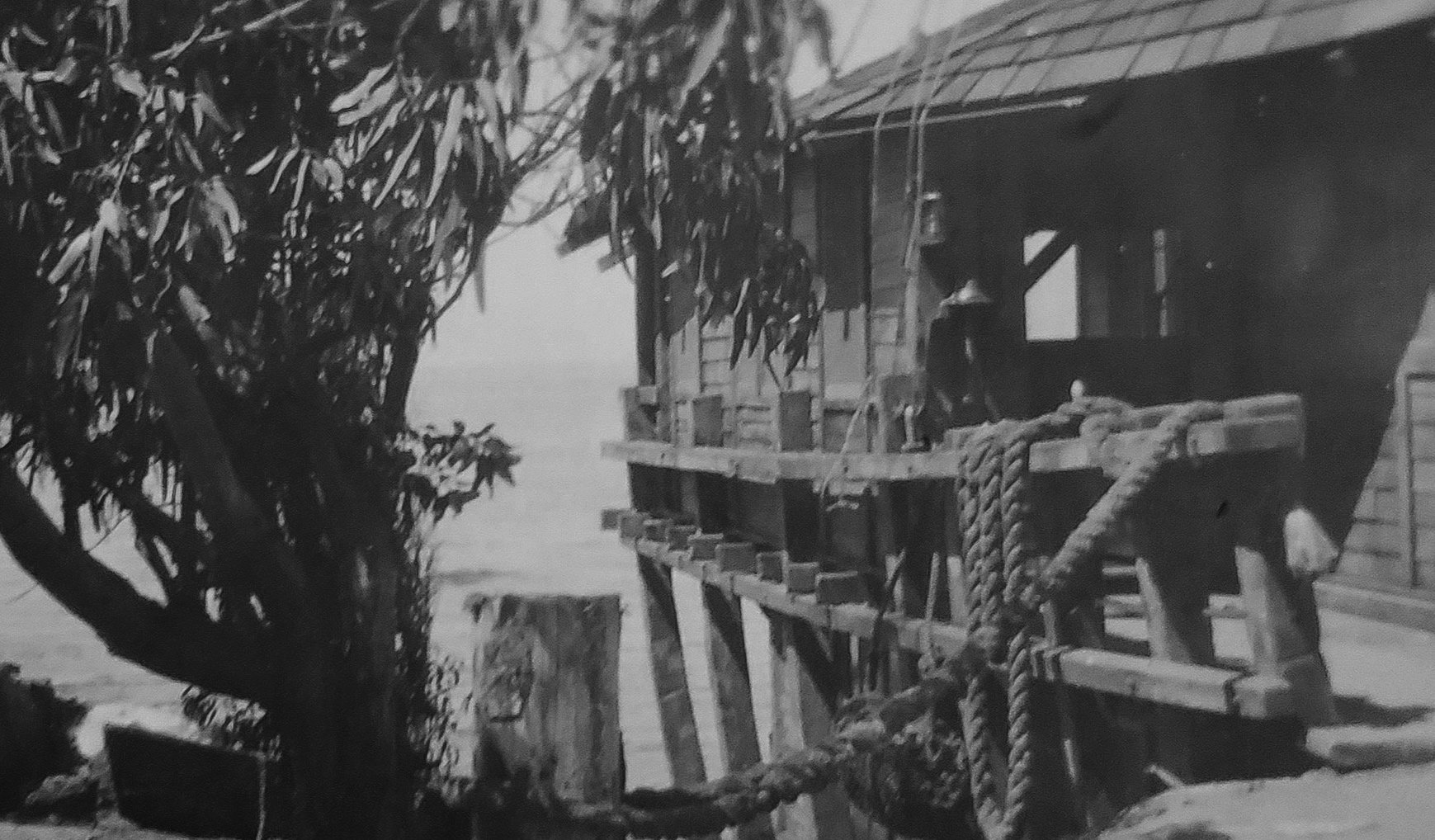
His earliest architectural design work was done in Los Angeles County. In 1923 he was commissioned by Albert and Constance Braasch to design a residence in Eagle Rock. This project was followed by the Hanson Residence in Silverlake the following year. His first project in Laguna Beach was the famed Ark House at Woods Cove built in 1923. Three years later, Egasse was commissioned by Joseph Jahraus to design the Laguna Beach Lumber Company building, known as the Lumberyard, on Forest Avenue in the heart of that town. The partnership between Egasse and Jahraus resulted in something magical. The French Norman style structure with Storybook characteristics became his signature look. The Jahraus family hired Egasse a few years later to design the South Coast News building on Forest Avenue just off Glenneyre. This is a much smaller structure but possesses the same French charm. These two projects are really evocative of his later work. Egasse executed several residential commissions in Laguna Beach, some large, others more humble. He designed the Bruce V. Crandall home on Crescent Bay Drive in 1930, as well as his family’s personal residence on North Coast Highway in 1926.

JLE d’Argastel. Photo provided by Jeanne Egasse.
Jean Louis and Jessie raised their family in Laguna Beach. Both of their children graduated from Tustin High School which all Laguna kids attended prior to the opening of Laguna Beach High. Very much a free-thinker, he had an interest in the Theosophy movement that thrived in the Southland in the early-twentieth century. He practiced yoga on the beach, a very exotic pursuit in the 1930’s. He also initiated a fencing club that briefly prospered before fading away in the early 1930’s. The Depression had a deep impact on his business and his marriage. In the mid- 1930’s Jean Louis Egasse for all intents and purposes disappeared. A December 14, 1942 article in the South Coast News referred to Egasse as the “…long since passed away…” father of his son, Yann. The Egasse family was shattered as well. Jessie returned to England and later remarried. His daughter, Jeanne, joined her mother. His son, Yann, remained in Laguna, a ward of the Perrin family. Yann had only limited contact with his father.
Despite the rumors of his death, Egasse was, in fact, very much alive. According to Yann Egasse’s daughter, Jeanne, Jean Louis left Laguna in the early 1930’s to escape creditors. Hoping for a fresh start, he moved to Santa Barbara and changed his name to J.L.E. d’Argastel. He remarried, ironically to another British woman named Jessie.
He did continue to work under his new pseudonym. He may have worked for the prominent Santa Barbara firm of Edwards and Plunkett in the late-1930’s. He clearly had some sort of professional relationship with J.J. Plunkett. Following Plunkett’s tragic death in 1946 at age 46, his widow tried to keep his firm, Plunkett and Associates going. J.L.E. d’Argastel was listed as an “architectural consultant” with that firm. Within a couple months, he had formed a partnership, the Building Arts Studio, with Richard B. Nelson. They advertised themselves as the “successors” to the Plunkett firm. The firm last only a couple years. In the fall of 1946 and again in the spring of 1947, d’Argastel taught a night school class on architectural design at Santa Barbara High School. He also designed his own residence on Dorking Street. The last project we have been able to link to Egasse/d’Argastel is a humble residence for a small group of Catholic sisters. A Santa Barbara News-Press June 12, 1952 article identifies d’Argastel as the architect of a convent building for the Sisters of Bethany that was built adjacent to the Spanish speaking parish of Our Lady of Guadalupe in that city. Given his lifelong dubiety to organized religion and to the Catholic Church specifically, it is ironic that this was his final commission. We visited the church and a friendly parishioner explained that the convent had been torn down several years earlier to make room for additional parking; they literally paved paradise and put up a parking lot. None of these later projects captured the originality of his Laguna Beach works. Jean Louis Egasse died on August 5, 1965. His niche can be found in a small mausoleum at the Santa Barbara Cemetery. His widow survived him by 33 years and is interred only a few feet away from her husband. The name on his grave is JLE d’Argastel.

Egasse in Santa Barbara, standing at the home he built on Dorking Place.
Photo provided by Jeanne Egasse.

An ad in the Santa Barbara News Press, October 17, 1948.
Projects

The Ark
Egasse Residence
2191 Ocean Way
Woods Cove

1280 North Coast Highway
North Laguna

The Ark
297 Crescent Bay Drive
North Laguna

The Lumberyard
384 Forest Avenue
Downtown
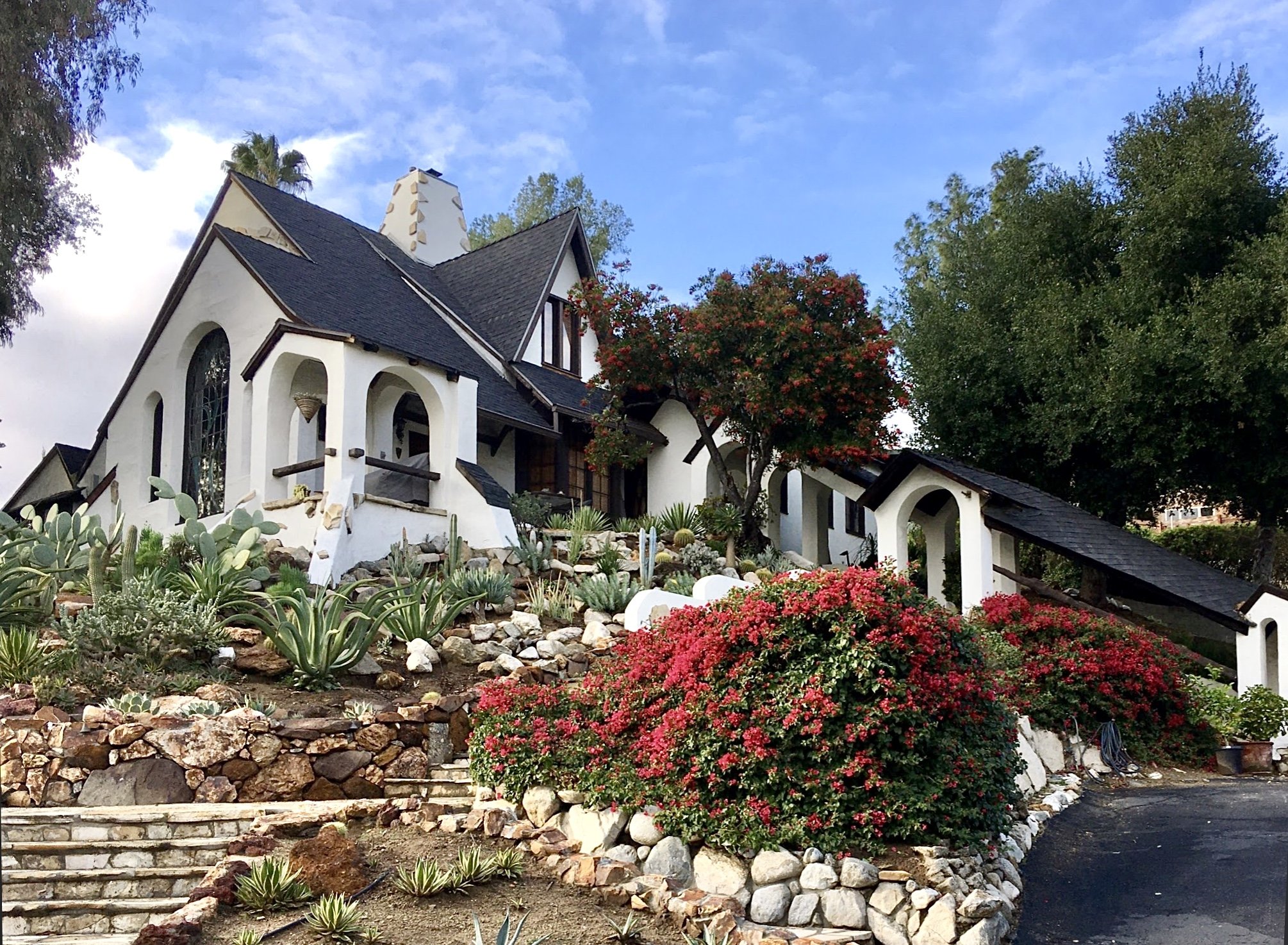

Photos by Craig Baker, 2018
Egasse-Braasche House
2327 Hill Drive, Los Angeles
Read more about the Egasse-Braasche house here.
Photos provided by The Historical Marker Database.
STAY TUNED for updates to Jean Louis Egasse’s portfolio.